

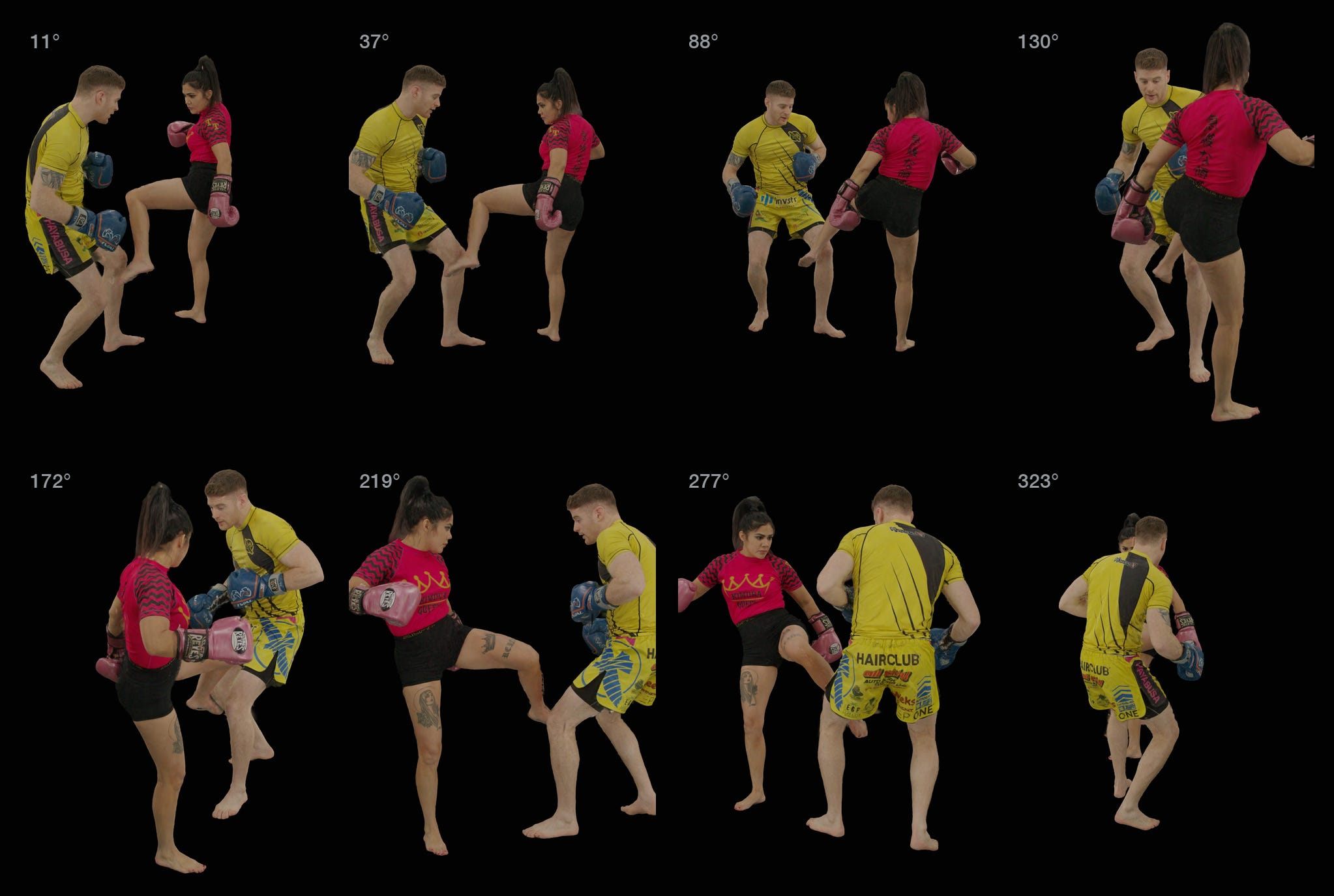
The eight images every method was given: one instant of a captured performance, rendered from eight virtual cameras whose positions are known exactly. Labels give each camera’s angle around the performers.
Video-generation benchmarks often score camera control by recovering the camera path from the generated frames and comparing it with the move that was requested. If the tool recovering that path is wrong, part of the error charged to the video model belongs to the tool.
A complete reconstruction is not the same as a correct one, and that matters beyond this test. We checked three camera estimators on one instant of a captured performance, and in some runs one of them, COLMAP, returned a full set of cameras with one pointing the wrong way.
Volumetric capture makes that tool testable. Once a performance is reconstructed, it can be rendered from virtual cameras placed anywhere around it, and the position and direction of each camera are known exactly before a single image exists. Give an estimator only the images, and its answer can be checked against cameras it never saw. The performers are still a reconstruction, so the test says nothing about how faithful the scene is. It says whether the estimator can recover the cameras that made these images.
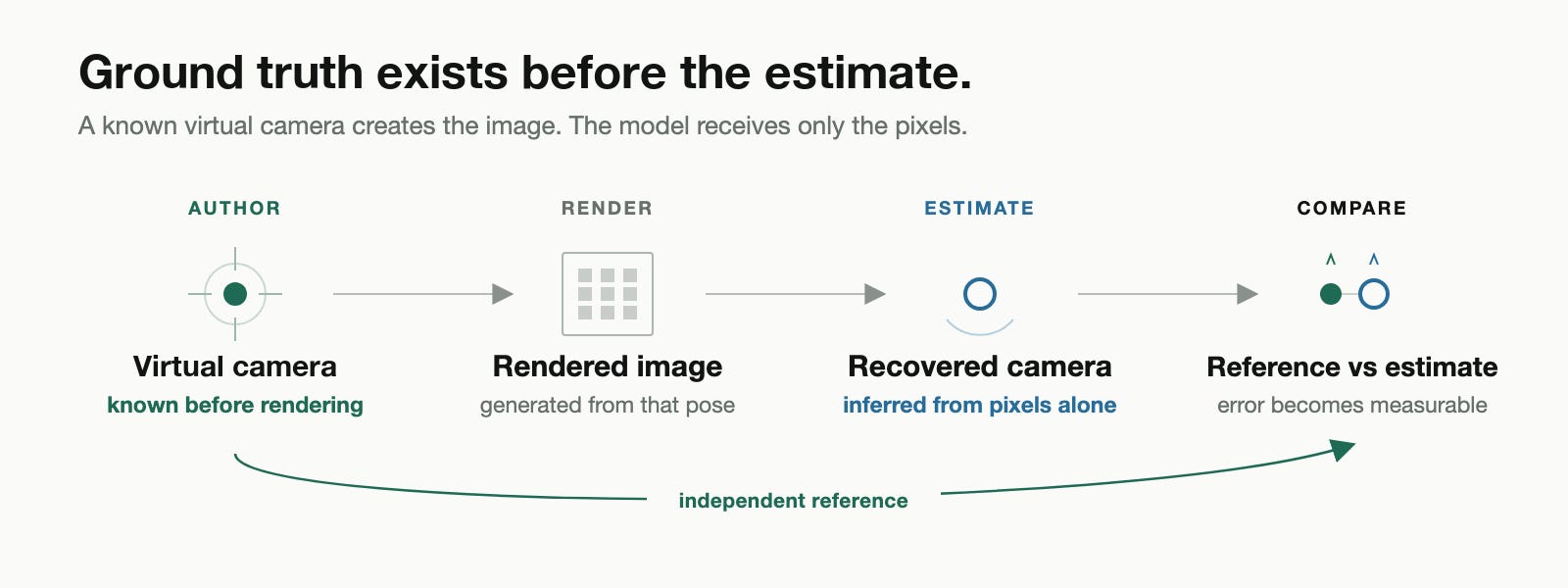
The camera is fixed before rendering. The estimator works from the pixels alone.
One instant, eight cameras
The test used eight renders of a single frame from a captured boxing drill. Every method got the same images and was scored against the same eight cameras, using its own documented preprocessing and calibration settings.
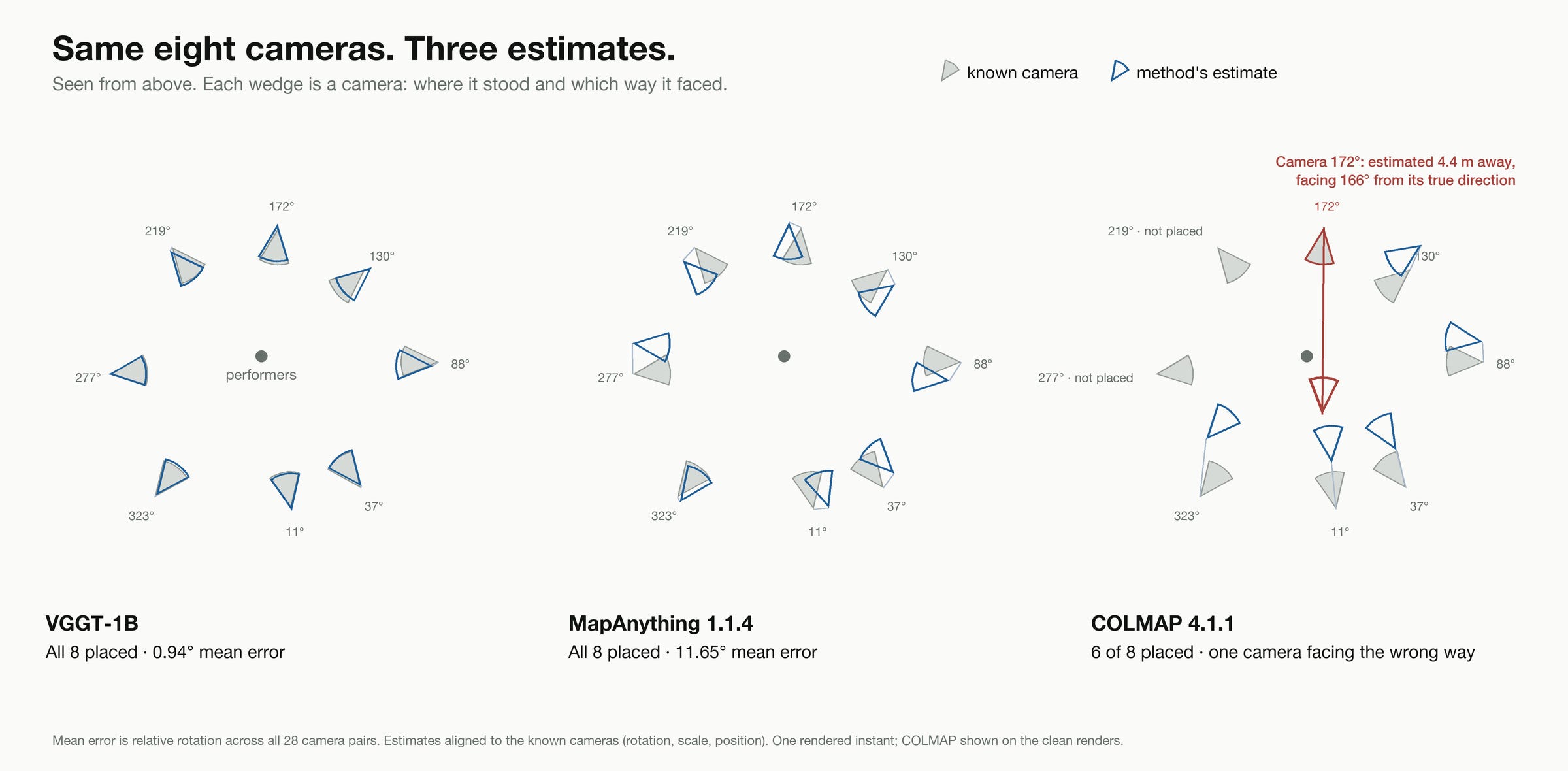
Seen from above: where each method put each camera, and which way it pointed. COLMAP is shown on one clean run; the sweep below tests how stable that result is.
VGGT-1B recovered all eight cameras with a mean rotation error of 0.94°. MapAnything 1.1.4 also returned all eight, at 11.65°. Both figures average the error in relative orientation across all 28 pairs of cameras. VGGT matters here as a control: the scene can be solved accurately, so larger errors on the same images come from the method, not from an impossible scene.
COLMAP never placed all eight cameras on the clean images, in 12 dedicated repeats or in 15 more clean runs during a later 75-run sweep. In that sweep, adding mild noise, compression, downscaling or lens distortion sometimes helped it find more cameras. But finding more didn’t fix the one it got wrong: the six runs that placed all eight cameras all had the camera at 172° turned more than 90° from its true direction.
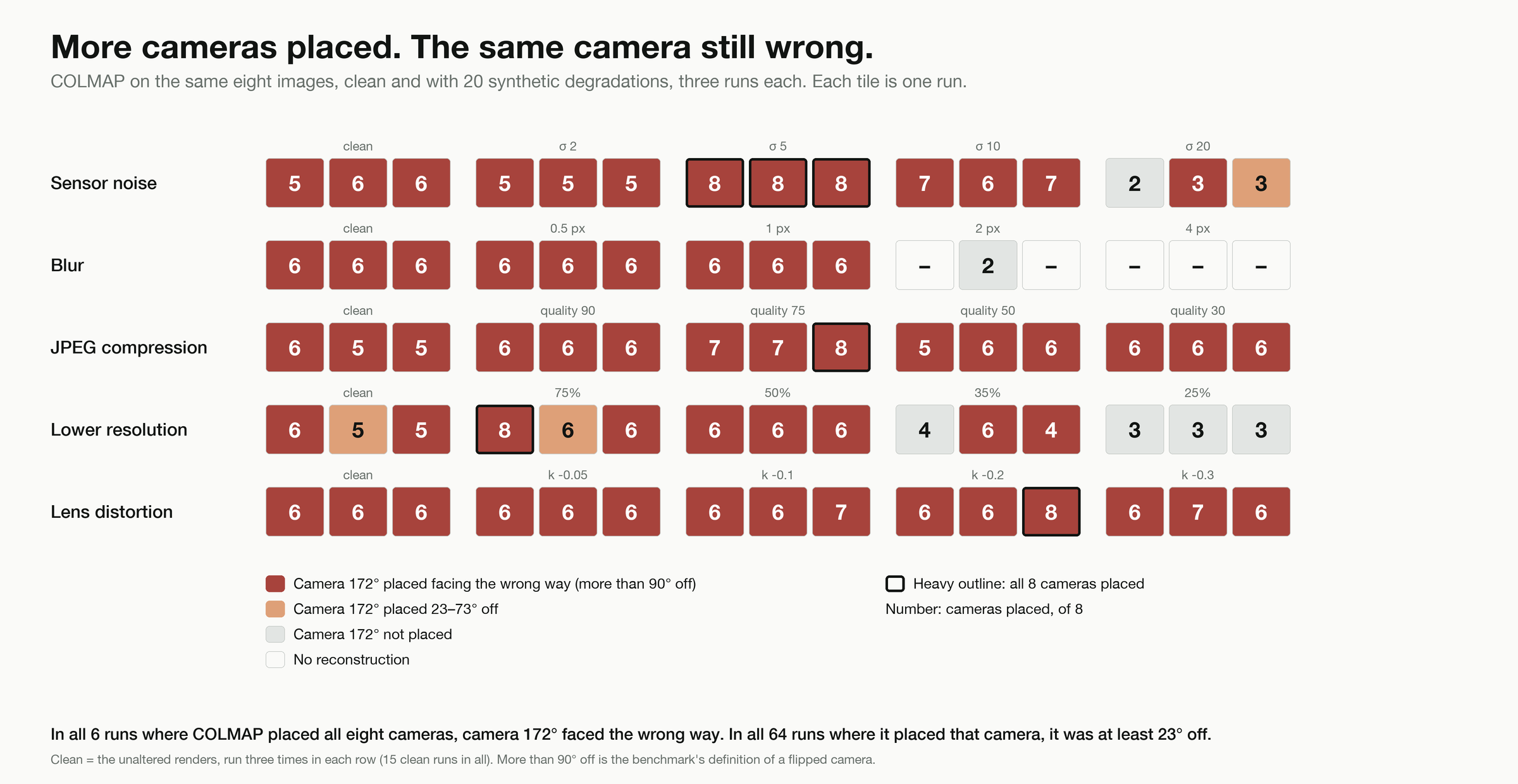
Each tile is one COLMAP run: 15 on the clean images and 60 with added noise, blur, compression, lower resolution or lens distortion. The number is how many cameras it placed; outlined tiles placed all eight.
Placing a camera for every image doesn’t mean the cameras are right. This is one scene at one instant, so it isn’t a ranking of these three systems or a prediction of how they do on ordinary footage. What it shows is that a known reference catches an error the method’s own output never flags.
When the estimator is part of the metric
This is already how camera control gets scored in published work. Latent-Reframe uses DUSt3R to estimate camera poses for its camera-error metrics, and ReCamMaster uses GLOMAP to recover poses before computing rotation and translation error.
When a recovered path differs from the requested one, the video model may have missed the move, the estimator may have misread it, or both. The two errors can add up or partly cancel, and the score alone can’t say which.
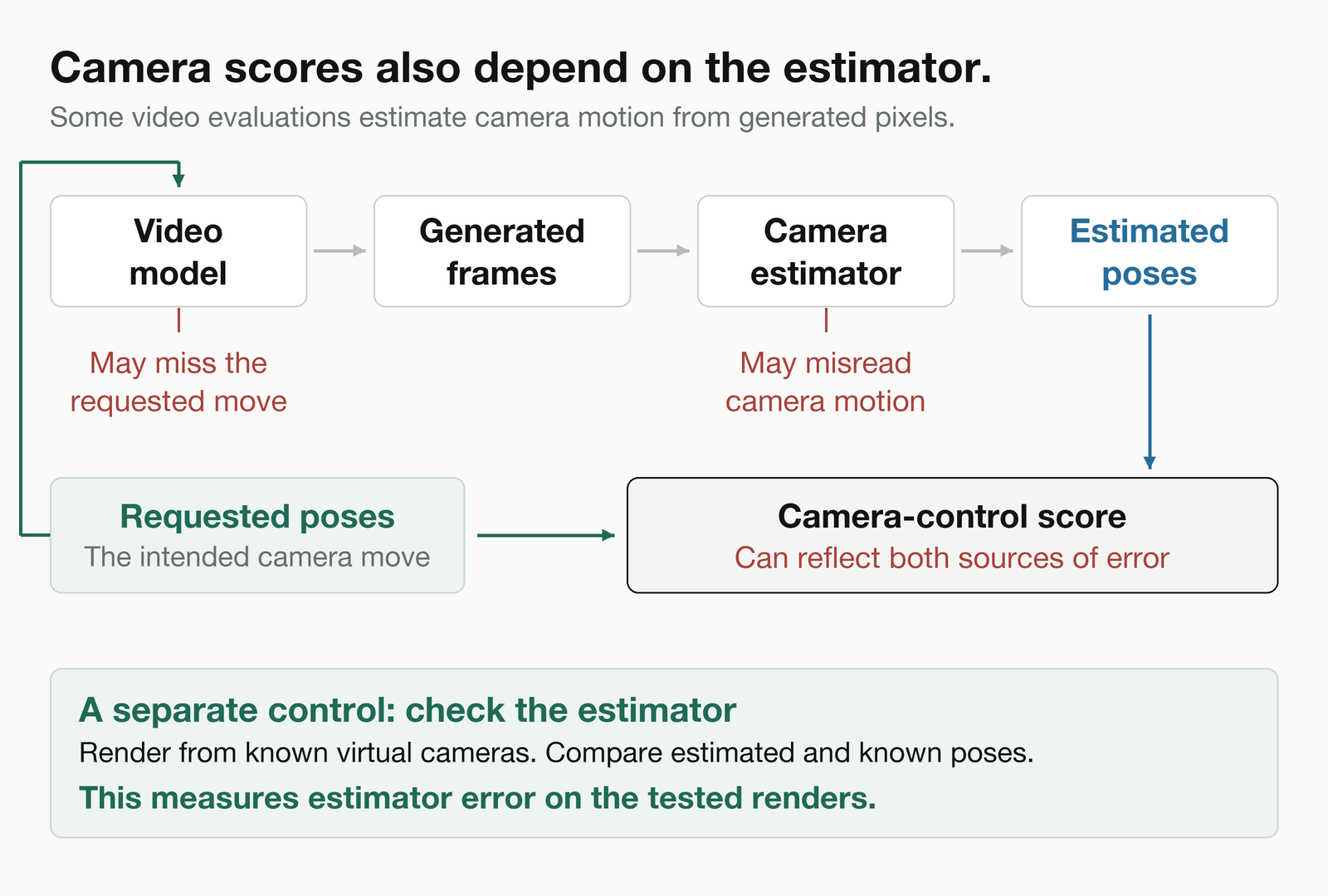
A camera-control score can carry error from the video model and from the estimator. Known-camera renders measure the estimator’s share on its own.
Known cameras give the estimator a test of its own: render from them, ask for the poses, compare. That measures its error on those renders, and the result carries over only as far as the renders resemble the videos being scored. This test didn’t run DUSt3R or GLOMAP, and it doesn’t produce a correction to subtract from anyone’s score. It is a control those benchmarks could add.
Checking the reference
The known cameras are only useful if the rendered images actually match them. A separate check held the cameras fixed, triangulated features matched across the eight images, and projected those points back into each view. The average reprojection error was 0.86 pixels over 617 observations, and a fitted focal length came within about 0.5% of the 42° vertical field of view the cameras were set to. Part of that residual comes from detecting and matching features independently in each image, so it isn’t expected to reach zero.
That confirms the virtual cameras and the pixels agree. It doesn’t say how closely the reconstruction matches what real cameras saw. That depends on the physical capture: how accurately the stage cameras were calibrated, and how well the performers were reconstructed from them. On the first of those, Evercoast’s calibration and registration system solves to a mean reprojection error of 0.2 px across the whole rig. That doesn’t change the reference here, since the virtual cameras are exact either way, but it bears on how far results on these renders carry over to real footage. The second, how faithfully the performers are reconstructed, takes a different experiment: leave one real camera out of the reconstruction, then compare its recorded frame with a render from its calibrated position. For anyone using captures like this as training or test data, that’s the next question, and it deserves its own write-up.
Beyond camera pose
The same setup could test depth estimators, using the renderer’s depth as the reference. That reference would describe the reconstructed scene rather than the physical world, and would need clear rules for translucent or overlapping splats.
Any measurement that can be checked against a captured scene can be tested this way before it is used to judge something else. For camera-controlled video, that turns a single score into a sharper question: when the number moves, how much of the change is the video, and how much is the tool measuring it?
Evercoast captures people in motion from synchronized, calibrated camera arrays, so each performance can be re-rendered from any viewpoint with the cameras known exactly. If you’re evaluating camera estimators, video models or other perception systems and want a known reference to test against, get in touch.